Wednesday, 12 February 2014

Telecom and the Federal Budget 2014
The Federal Budget released on 11 Feb 14 had a few sections affecting
telecommunications. The full budget and related information can be found
starting at the
budget home page. Information about telecommunications
can be found in Chapter 3.4 pages 177 to 180.
In the cellular arena, the budget calls for amending the Telecommunications
Act by introducing a cap on “wholesale domestic roaming rates to prevent wireless
providers from charging other companies more than they charge their own customers
for voice, data and text services.” This action is obviously being introduced
to help the new entrants –, Mobilicity, Vidéotron and Wind – who rely on the
incumbent carriers for network access (roaming) outside their home area. There should be little direct impact on the average
consumer unless they are a new entrant customer and the companies decide to
pass the potential savings on to their customers. On the other hand, there is
the chance the incumbents could adjust their rates to make-up for any loss
income.
The budget implies that the cap will be temporary and may be
adjusted as a result of the ongoing CRTC study of Canadian
roaming rates
The Telecommunications Act will also be amended to give
Industry Canada and the CRTC “the power to impose administrative monetary
penalties on companies that violate established rules.” Some of the target
infractions relate to the Wireless Code, spectrum deployment timelines, service
to rural areas and tower sharing.
There are also a number of areas that the government feels
need addressing including such as:
- Enhanced information sharing amongst the CRTC, Industry Canada and the Competition Bureau;
- Clarify the elements of the spectrum auction rules; and
- Clarify the prohibition on jamming devices.
There is an additional one that I do
not quite understand so I will quote it in full:
“Provide the CRTC with the authority to impose conditions
pertaining to social requirements on telecommunications service providers that
are not carriers (i.e. “re-sellers” of services) to help ensure that all
consumers can benefit, no matter which provider they choose.”
On the broadband (high speed) Internet
side of the house, the budget identified the sum of $304 million over five
years “to extend and enhance access” broadband access networks. The body of the
document also mentions “enhancing and extending access.” This is a subtle change
to previous funding programs which could not be used to enhance or improve
existing services.
One has to question the targeted
speed of 5 Mbps. While this may be considered barely adequate today, I suspect
that by the time implementation actually takes place it will be borderline acceptable.
Also, the budget does not address
the issue of the fiscal digital divide. The fact remains that many people
cannot afford the hardware and recurring charges associated with getting Internet
service in their homes.
The telecommunications section ends
with a short discussion of the use of spectrum to deliver broadband in rural
areas. It reinforces the previously espoused principle of “use it or lose it” where
licensees are given a specific time period to implement the service roll-out or
lose the license.
It is a fact that while cellular broadband
and data is the fastest growing segment of the market and in the rural areas
the cheapest for the vendors to install, it is also the most expensive for the end
user on a monthly billing basis unless a special tariff is created.
The section ends with this statement:
“…an additional 280,000 Canadian households, which represents near universal
access. The Government will announce further details about the new program in
the coming months.”
One can only hope that they learned from their previous efforts and the new program shows a vast improvement.
Stay tuned for additional news.
Tuesday, 21 January 2014
New Cell Sites in North Sault
I have received various reports that Bell has recently activated
a number of cell sites in the Goulais and Wawa areas.
The new Goulais sites are Goulais Bay (Pine Shore Road),
Nils Bay, and Kirby’s Corner. These sites are in addition to the existing Bell
sites at Batchawana Bay, Havilland (Buttermilk) and Heyden. The site at Havilland
Bay will likely come on line in the second quarter of 2014. See the map below.
St. Joseph Island sites are still under construction.

There are also three sites in the Wawa area that are now operational. See the map below.
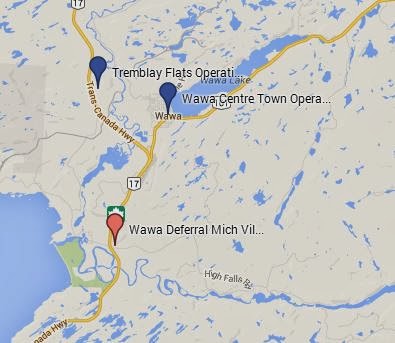
While the sites were built as part of the Deferral Account project,
the full Deferral Account service option is not scheduled for commissioning
until end July 2014. The Deferral Account network cell sites are designed to provide
maximum broadband (high speed) Internet service coverage using a data hub connected
to an external antenna. Standard cell voice and data service is a side benefit.
Because of this, it may be possible that data hub service will be better than voice
service in some areas.
Once Bell is ready to activate the Deferral Account area,
they will do a advertising blitz to inform local residents about the program.
Saturday, 18 January 2014
Bell Deferral Account Report Released 17 Jan 2014
The CRTC released the Bell Deferral Account report for the
4th Quarter of 2013 on Friday 17 Jan 2014.
Unlike previous reports, there is some useful data left in
this report instead of being redacted. There is still a lot of information I would like to
see and cannot think of any compelling reason why it is blacked out. (They
actually use the # symbol which is ironic considering how the hash tag is used
in other applications to highlight available information.)
The new uncensored information provided by Bell is entitled “Service
Ready Date”. The dates for the Algoma
District Deferral Account areas are:
Area
|
Date*
|
Echo Bay
|
31 Aug 2014
|
Goulais
|
31 Jul 2014
|
SSM-Airport
|
31 Jul 2014
|
St. Joseph Island
|
30 Jun 2014
|
Wawa
|
31
Jul 2014
|
∗
Latest planned date. Could be earlier if all is ready
Bell indicated they are still having problems with
local residents in some areas about the location of towers. The main complaints
centre on aesthetics, height of the tower, and avoidance lighting. When
comments about the health impact are included, the list pretty well covers the
majority of adverse comments brought forth at public consultations. There have
been a number of sites in the Algoma District that have been moved (on paper)
in response to local input.
Bell has also had a few problems with backhaul networks. A
crushed conduit under the highway near Marathon means they will be relying on
radio backhaul instead of fibre optic cable for a while.
In December 2013, the CRTC specifically asked Bell about the
use of an external antenna. While Bell stated “there has been no negative feedback from our customers related to the use of
such antennae and that in the marketing materials we send out to the
communities to be launched, we advise our potential customers that the use of an
external antenna is required.”, they did not comment about any other feedback
for the service in general. In particular, has Bell designed a solution that
can handle network congestion?
Finally, there are
a number of small inconsistencies in the dates used in the written report document
and those used in the spreadsheet. In most cases this is only a month or two
but does show a lack of attention to detail which I hope is not reflected in network
design.
The full report is available
on the CRTC
website. Scroll down to 2014-01-15 - Bell Canada
Tuesday, 24 December 2013
Bell Deferral Account Report for Third Quarter 2013
Bell submitted the third quarterly Deferral Account update
report to the CRTC on 15 Oct 2013. For some inexplicable reason, the CRTC released
the public version of the report under a different file folder number than
previous quarterly reports and it took some effort to locate it.
For the uninitiated,
there are two versions of the quarterly reports. A fully detailed report with
actual facts and figures is submitted to the CRTC for internal use and a
redacted report with most facts and information
which may be of interest to the public (or according to Bell – the competition)
replaced by # signs. This is allowed under
terms of the Telecommunications Act and CRTC policy.
The actual statement of justification as used by Bell in
their submission is:
“Release of this
information would provide potential competitors with invaluable
competitively-sensitive
information that would not otherwise be available to them, and which would
enable them to develop more effective business strategies. Release of such information could prejudice
Bell Canada's competitive position resulting in material financial loss and
cause specific direct harm to Bell Canada.”
I have not figured out how not listing a tower location on a spread sheet prevents a competitor from seeing a 90 metre tower with cellular antennas that is visible from a public road and deducing some competitively-sensitive information.
Like previous
reports, the latest one provides little actual information which can be applied
to the Algoma District situation. The target date for completion of the project is still August 2014. It was possible to glean more information through
backdoor resources and physical observation during drive abouts as noted in
previous blog entries.
Apparently the CRTC
also has concerns with the Bell reporting content. Consequently, in a letter
dated 16 Dec 2013, they directed Bell to submit additional information in their
reports as follows:
“The Commission notes that there are still many activities to be
completed within the next nine months and that, more specifically, construction
of wireline transport backbone to 17 approved communities must be both started
and finished within the first eight months of 2014 in order to meet the August
deadline.
The Commission also notes that the Bell companies indicated in
their July 2012 report that they needed to provide most consumers with an
external antenna to deliver quality service. However, no update on this
situation was provided in subsequent reports.
Consequently, the Commission directs the Bell companies, in
their 15 January 2014 report, to
a) update their risk assessment and mitigation strategy for the
last eight months of the rollout, and
b) provide a summary of any evaluations of the service quality delivered to
consumers using the external antenna in deferral-account-funded communities.
Further, the Commission directs the Bell companies, beginning in
their January 2014 report and continuing in subsequent quarterly reports, to
refine their forecast for the period of January to August 2014 by
1. specifying, for each of the remaining communities, in which
month
a. the remaining towers are to be completed (column H) [1],
b. construction of wireline transport is expected to start (column J),
c. construction of wireline transport is expected to be completed (column K),
and
d. service will begin (column L), versus specifying a single date of August
2014 for all communities; and
2. providing a summary of the number of new towers forecasted to
be completed in 2014, by month.
Additionally, in their subsequent quarterly reports, the Bell
companies are to identify where any changes have been made to the forecasted
month for each of the items in 1. above.”
Sunday, 15 December 2013
Bell Data Hub Overages and the Wireless Code
I have been
exchanging e-mail with a user in East Algoma about the high cost of Bell data
hub service. He was getting monthly bills in the $200.00 - $350.00 range
for a 4 user household with a mix of computers and smartphones. All the hardware used the data hub’s WiFi
capability when they were within range.
Of late, he
was getting cutting off at $100.00 overage and had to contact Bell to get
reconnected.
Needless to
say, he was not happy with both the price and the procedures.
I received
the following info from him recently:
“I just
received my Dec Bell bill and low and behold the max charge for data over 10 GB
is $50.00.
We used $197 worth and they only charged $50 for that and waived $147.50.
Our bill for the month is $96.05; Relief finally.
I was suspicious and call them. It’s due to the CRTC Wireless Code.”
This is the
section of the Wireless Code that would seem to apply in this case:
Sec 3 - Cap on data overage charges
A service provider must suspend data overage charges once they
reach $50 within a single monthly billing cycle, unless the customer
expressly consents to pay additional charges.
A service provider must provide this cap at no charge.
My interpretation of this section was that once the cap was
within reach during a billing cycle, the vendor would contact the user,
normally by e-mail or SMS, notify them of the cap limit coming into force and
warning this would result in a cancellation of service until the end of the
billing cycle unless the user gave explicit permission to charge additional
overage fees.
Indeed, this is what was happening prior to 02 Dec 2013 when
the CRTC Wireless Code came into effect.
It will be interesting to see what happens with the January
billing cycle.
If this is in fact the long term Bell policy for handling
data hub overages, it will certainly be of tremendous benefit to rural
broadband (high speed) Internet users.
Friday, 15 November 2013
Tbaytel's Seasonal Service
I recently sent a query to the Tbaytel Community Forum
concerning the availability of a seasonal service option for Tbaytel customers
in the Algoma District. You may view the full query and the Tbaytel response at
this
link.
In short, Tbaytel offers a seasonal service option for “HSPA
Wireless Service” (Rocket/data hub) and “Regional Internet (Canopy) Service”. They recommended I contact Tbaytel Customer
Care at 1-888-264-9501 for additional information.
I could not find any reference to this offering on the Tbaytel
website. This is unfortunate.
Subscribe to:
Posts (Atom)